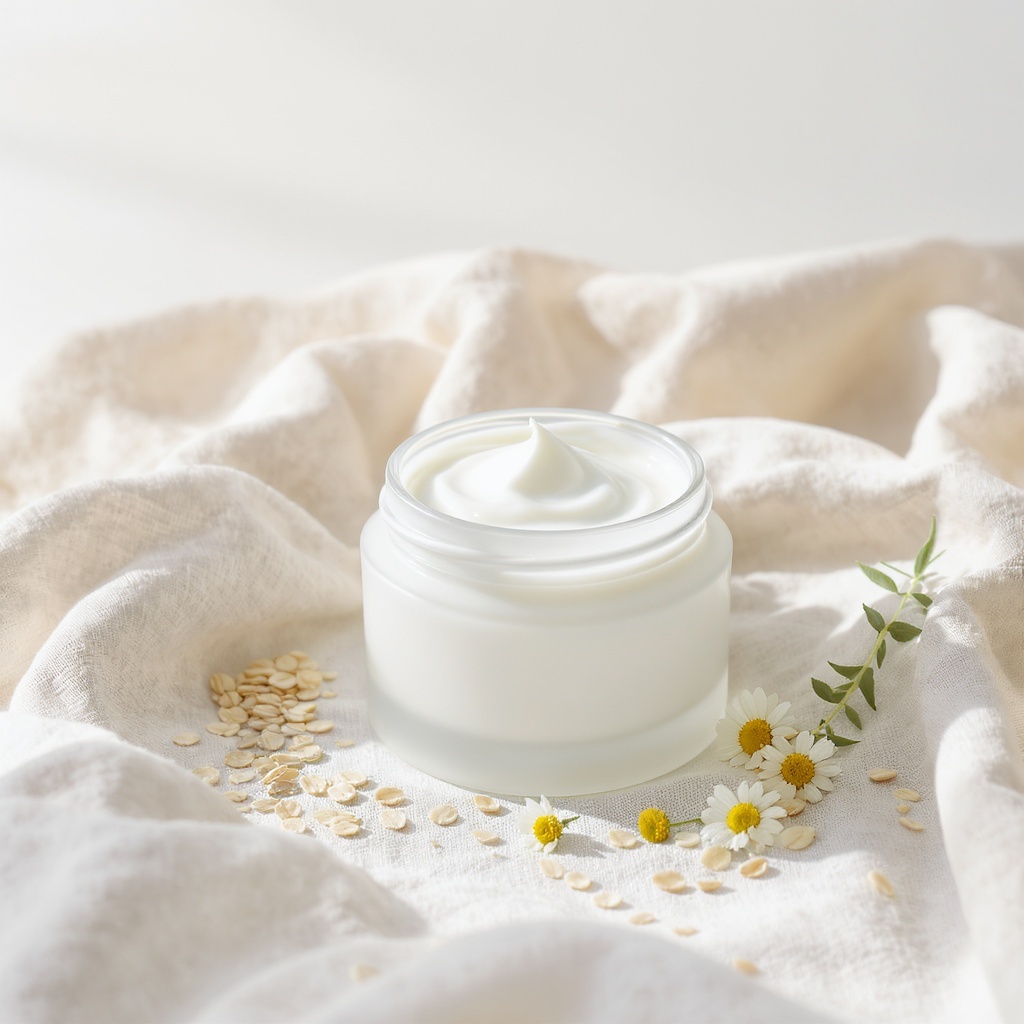
What winter does to the farm — and to skin
This is the first entry in a seasonal journal we'll be writing from the farm — what's happening here in southwest Michigan, what the animals and the herb beds are doing, and how the season is showing up in what we're making. Winter is the obvious place to start, because right now the question we hear most often from customers is some version of: "what should I actually be doing differently with my skin in this weather?"
The honest answer is: not a lot, if your routine is built around tallow. Tallow is, at its core, the same kind of fat your barrier is made of — palmitic, stearic, oleic — and skin absorbs it as something close to itself rather than treating it as foreign. In winter that matters even more than usual, because the dry indoor heat and the cold wind outside are working in opposite directions on the same barrier, all day.
The goats are back in the barn full-time, the bees are clustered around their hives in a tight ball to keep the queen warm, and the calendula beds are dormant under a layer of straw. We're rendering tallow low and slow as always, but the pace is slower now — winter suet comes in small batches, processed over a longer stretch, and the kitchen smells faintly of beeswax for weeks.
Wind-chapped lips are the first thing people around here notice in January. The tin on the windowsill — our Edible Sun Balm — does double duty as both SPF and the only thing that brings a wind-burned lip back overnight. That isn't a routine step. It's just what we keep on hand, all day, in this season.
The 3-step seasonal tallow routine
Three steps, designed for the cold months — and built entirely around two products you already have (or should have) on the bathroom shelf. Nothing exotic, nothing twelve-step. Just a clean face, a tallow-based moisturizer, and a barrier layer for the spots that get hit hardest.
Step 1 — Cleanse gently
Whatever you already wash with — bar, oil, milk — works fine. The point in winter is gentleness: don't strip the barrier with a foaming cleanser and then try to rebuild it with whatever you put on next, because the indoor heat has already pulled water out of the outer layer before you stepped out of the shower. Wash with something mild, leave the skin damp (not dripping, not bone-dry), and move on. If your cleanser tends to leave your face tight on a cold morning, the chamomile and oat base in our Moisturising Day Cream was chosen partly because it sits calmly on skin that has just been washed — no sting, no reaction.
Step 2 — Hydrate and seal
While the skin is still slightly damp, press in a pea-sized amount of Moisturising Day Cream. The oat, honey, and chamomile infusion handles hydration; the grass-fed tallow handles the seal. In winter you'll want a slightly more generous layer than you would in August — especially on the cheeks and around the eyes, where the dry-indoor-heat feeling shows up first. Give it thirty seconds. The cream absorbs cleanly and leaves no film.
Step 3 — Protect and spot-treat
Winter sun is weaker but still real — and where it hits bare skin over wind, it does the worst kind of damage: dryness and UV in the same spot. Press a thin layer of Edible Sun Balm onto the high points where winter wind catches first — cheekbones, nose, brow, the tops of shoulders if you're outside for more than ten minutes. The non-nano zinc does the sun-blocking work; the beeswax grip is what holds it on through the cold. On days you'll be inside all day, use the same balm as a spot treatment on any cracked or wind-burned patches — it's the same tallow-and-beeswax formula doing the same job.
What changes when the season does
This is chapter one of an ongoing journal. The next entries will follow the year around — what the farm looks like in spring, what the bees are doing in summer, what the goats are eating in the fall — paired with whatever routine adjustments each season actually calls for. The principle stays the same. The specifics tune to the weather, and so does the weight of every layer you put on.
If you'd like a more personal starting point than a routine written for everyone, Find your seasonal routine → and answer four questions. It takes about a minute, and the result is built from the same two products plus a recommendation on how heavy to go in this particular season.